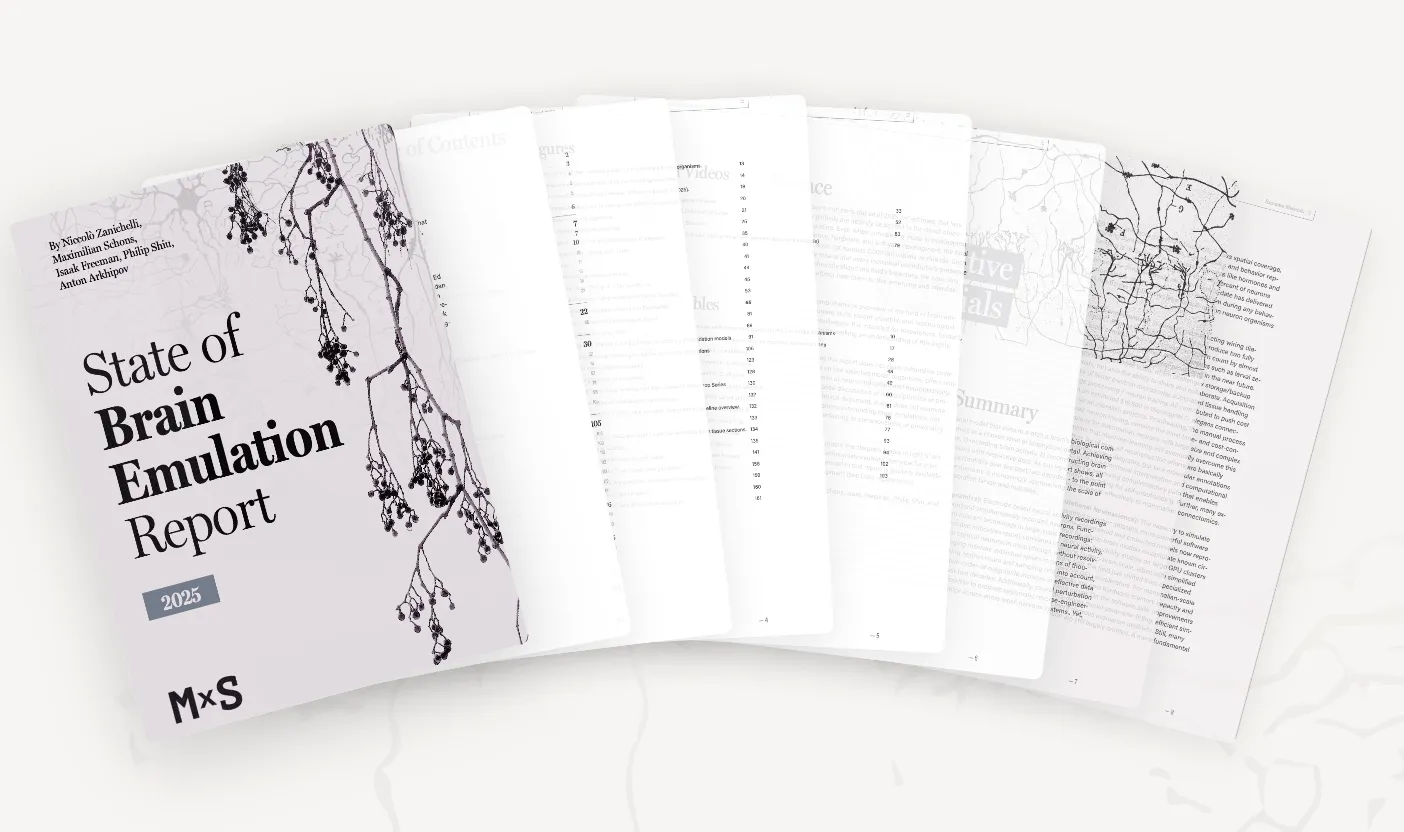
State of Brain Emulation Report 2025
“The most useful quantitative update I’ve seen on the whole brain emulation roadmap. A treasure trove of useful information.” — Anders Sandberg, Institute of Futures Studies
Fifteen years ago, Bostrom and Sandberg’s Whole Brain Emulation whitepaper was the reference document for this field. Since then: light sheet microscopy, expansion microscopy, optogenetics, modern machine learning. The technological landscape transformed, but no one had synthesized it.
Fewer than 500 people globally work on brain emulation. The field needed an accessible, comprehensive update to attract new talent and enable serious planning.
In November 2024, Isaak Freeman and I set out to write a really good article about brain emulation. We quickly realized we lacked the basis for half our claims. The literature was scattered across hundreds of papers, the roadmaps were outdated, and the actual state of the field lived mostly in private conversations.
So we started taking notes. Then more notes. Eventually we had hundreds of pages and a decision to make: write a summary or do this properly.
We did it properly.
What we built
This page can’t convey the breadth and depth of this project. Go to brainemulation.mxschons.com to get a real sense.
The core is a 175-page technical report covering neural recording, connectomics, and computational neuroscience across five model organisms, from the 300-neuron worm to the 86-billion-neuron human brain. 41 expert contributors from MIT, UC Berkeley, Allen Institute, Harvard, and Google reviewed and shaped the work.
But a PDF wasn’t enough. We wanted this to actually reach people. So we built an ecosystem:
- Full Report — 175 pages of technical analysis
- Asimov Press Article — “Building Brains on a Computer,” a narrative entry point for non-experts
- Budget Guesstimator — A working cost calculator for brain emulation projects
- Figure Library — 38+ publication-quality figures, free to reuse
- Data Repository — 24 curated datasets with 2,086 data points
Working on this report changed my own thinking. I now find it genuinely plausible that we’ll see brain emulation at human scale within my lifetime. That’s a strange thing to write, but the data supports it.
Open Infrastructure
Something I’m particularly proud of: we went the full way on openness.
The GitHub repository contains everything. All 24 datasets. All figures in high resolution. All code for the Budget Guesstimator. Every calculation formula with its description, units, and inputs documented.
The Guesstimator itself lets you configure a brain emulation project: select your target organism, choose imaging modality, and get detailed cost breakdowns. But unlike most models in emerging fields, this one isn’t a black box. Every parameter is auditable. Anyone can verify the math, challenge assumptions, or propose updates by editing TSV files.
This matters because brain emulation has historically felt like a sci-fi topic, with estimates scattered across private spreadsheets and informal conversations. We wanted to put the field on a solid, shared scientific foundation. A centralized resource that creates consensus, enables disagreement, and compounds over time as others build on it.
Collaborators
- Niccolo Zanichelli — LinkedIn · Amaranth Foundation
- Isaak Freeman — LinkedIn · MIT Synthetic Neurobiology · Personal site
- Philip K. Shiu, PhD — LinkedIn · Google Scholar
- Anton Arkhipov, PhD — LinkedIn · Allen Institute · Google Scholar
- 41 additional expert contributors
Funders
Fieldcrest Ventures, MxSchons GmbH, Foresight Institute
Timeline
- November 2024: Project begins
- October 2025: Preprint on arXiv
- January 2026: Final report with complete data and figures
Explore the full project at brainemulation.mxschons.com